
Buying sunglasses online is a confidence problem more than a product problem.
You can read every review, zoom in on every angle, compare measurements across five tabs, and still hesitate at checkout. The question isn't whether the frame is good. It's whether it will feel right on your face. Whether the color will read the way it does in the photo. Whether the brand will make it easy if something is off.
We sell sunglasses online, so we think about this constantly. This is the honest guide we'd give a friend: what to actually check, what the numbers mean, and how to buy with confidence from any independent brand, including ours.
The one mistake almost everyone makes
Before anything else, here's the single most common mistake we see people make when buying sunglasses online, based on the emails and messages our team reads every day:
They fixate on how the frame is going to look on them before it arrives.
They scroll, they zoom in on the product photos, they pull up reference images of other people wearing similar frames, they compare angles, they second-guess for three days, and then they either buy the wrong thing for the wrong reason or they don't buy at all.
It's a losing approach. No amount of staring at a product page will tell you how a frame will actually sit on your face. That is true for us and it is true for every eyewear brand in the world.
The better approach is to reduce the risk of the purchase instead of trying to eliminate the uncertainty before it. That is what the rest of this guide is about.
1. Understand the three numbers on every frame
Every quality eyewear brand lists three measurements, usually in this format: 52-20-145. These are the most important numbers in the entire purchase. Here's what they mean.
Lens width (52): The horizontal width of one lens, in millimeters. Typical range is 48 to 58mm. Smaller numbers mean a more compact, refined silhouette. Larger numbers read bolder.
Bridge width (20): The space between the two lenses, across your nose. Typical range is 14 to 22mm. This is the single most important number for fit. Too narrow and the frame pinches. Too wide and it slides.
Temple length (145): The length of the arm that extends over your ear. Typical range is 135 to 150mm. Most faces fit comfortably in the 140 to 145 range.
If a product page doesn't list these three numbers clearly, that's a flag. Not a dealbreaker, but worth an email to the brand before you buy.
2. Find your reference frame
The fastest way to buy sunglasses online with confidence is to measure a pair you already own and love. Lay them flat, find the three numbers (often printed inside the temple arm in small engraving), and use those as your baseline.
If the pair you're considering is within 1 to 2mm on each measurement, the fit will feel familiar. If it's off by 4mm or more in any direction, expect a noticeably different feel. That's not good or bad, just information.
A few millimeters matter more than people realize. We have delayed frame launches over a temple tip that came back from production a couple of millimeters off our signature spec. Most customers would never have noticed. We notice. We send the frame back until it is right. That is the kind of tolerance that separates frames built to be kept from frames built to be replaced.
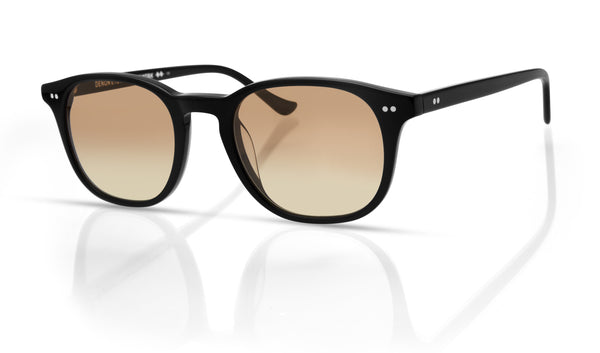
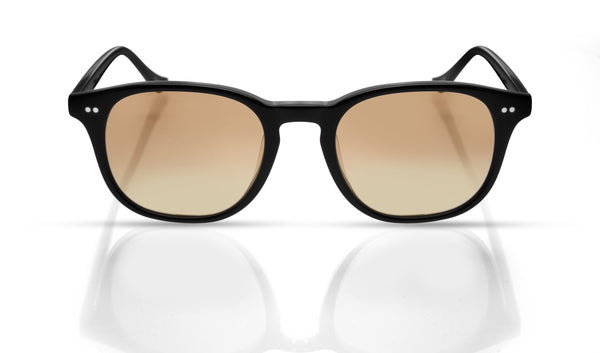
No reference frame to measure? Look at on-face imagery of the frame being worn, not just the flat product shots, and cross-reference with the measurements. This is why we publish on-face imagery directly below the add to cart button on every product page. It is also why we photograph our frames the way we do in this post, so the frame reads in person almost exactly the way it reads on the page.

3. Read the material story, not the marketing copy
"Premium materials" means nothing. What you want to know is specific.
For acetate frames
Ask whether it's sheet acetate or injection-molded acetate. Sheet acetate is cut from pressed blocks, hand-finished, and holds color and polish beautifully over time. Injection acetate is melted and poured into molds, faster and cheaper to produce, but lighter in both weight and feel. Every Denon acetate frame is cut from premium sheet acetate, which is why the color has depth and the weight feels substantial in hand.
For metal frames
Ask about the hinges. Cheap metal frames use stamped or welded hinges that loosen within a year. Better frames use real rivet hinges, mechanically pinned and built to be adjusted and serviced over time. It's a small detail that separates frames you replace from frames you keep.
For lenses
At a minimum, sunglass lenses should offer full UV400 protection. Beyond that, the question is whether the lenses are CR-39 (a lightweight optical plastic with excellent clarity), polycarbonate (more impact-resistant, slightly less optically pure), or glass (heaviest, most scratch-resistant). Every Denon sunglass ships with true CR-39 lenses, the same material used in prescription optical lenses, chosen for clarity and optical accuracy.
4. Check the return and exchange policy before you buy
This is the part most buying guides skip. Don't.
Every online eyewear purchase is, functionally, a try-on. The return policy is what makes the try-on possible. Here's what to look for, and what to expect.
- Window length: Most brands offer 14 to 30 days from delivery. Shorter windows tend to mean stricter condition requirements. Longer windows often come with restocking fees. There's no free lunch.
- Condition requirements: Read carefully. Most brands require the frame unworn outside, with all original packaging, case, and cleaning cloth included. If you receive a frame and decide it's not for you, try it on briefly indoors, in front of a mirror, and keep everything in the box.
- Return authorization: Reputable brands require you to email for a return authorization (RA) number before shipping anything back. This protects both sides. It also means there's a human on the other end you can ask questions of.
- Return shipping: Some brands make you pay for the label, some cover it. Worth knowing before you buy.
- Warranty: Separate from returns. A one-year defective warranty on manufacturing issues is standard for quality eyewear. It won't cover accidental breakage or scratched lenses, but it should cover anything that fails under normal use.
For reference, Denon's policy is 14 days from delivery for returns, with the frame unused and all packaging included. We require an RA number issued by our team at orders@denoneyewear.com before you ship anything back, and we cover the return shipping label so the return itself is frictionless. A restocking fee applies per our published policy. Our one-year warranty covers factory defects, inspected by us. The full policy is linked in the footer of every page on our site.
We keep the window tight because we build frames to be kept, not cycled through. A reader who knows this going in makes a more confident choice, opens the box carefully, and almost never needs the policy. That's the point.
In 2020, my father Joseph, my sister Sophie and I started Denon because we had watched the eyewear market for years get quietly consolidated into a handful of conglomerates, all protecting margin by cutting corners on materials, manufacturing, and the customer experience the independent optical practices we cared about deserved. The frames all looked the same. The service all felt the same. Denon was our answer to that.
The way it shows up in practice is in how we handle customers. Last year a customer ordered our Jelena frame and it did not fit her. We worked with her over email as a personal style guide, walked her through alternatives, and made the exchange to Lorenzo work at no cost to her. She has since bought every colorway of Lorenzo we make.
Another customer first discovered Denon at one of the independent retailers that carries us in New York City. When she moved to Florida where there was no Denon retailer nearby, she bought the same frame again online because she missed wearing it. She now buys every new release we drop. Our guarantee is simple. If you buy a Denon frame once, you will feel the difference. After that, the only question is which one is next.
Julian, Co-Founder, Denon Eyewear New York
5. Pick the frame shape that matches your face, not the trend
Trend cycles are short. A frame you buy because it looks right on your face will outlast any trend by a decade.
Here's the shorthand we give customers:
- Oval and rounded faces: Angular frames add definition. Rectangles, cat-eyes, and geometric shapes work well.
- Square and angular faces: Curved frames soften. Rounds, ovals, and aviators work well.
- Heart-shaped faces: Bottom-heavy frames balance a wider forehead. Aviators, cat-eyes, and wider lenses work well.
- Longer faces: Wider frames with horizontal emphasis shorten the face visually. Oversized squares, rectangles, and classic aviators work well.
This is a starting point, not a rule. The best frame is the one that feels right when you put it on, not the one that matches a chart.
Four Denon frames to consider
If you are shopping us specifically, here is the shortlist our team reaches for when someone asks.


Carolyn is our bestseller for a reason. A refined oval silhouette that works across face shapes and reads quiet luxury without trying. Isabella is the soft cat-eye for anyone wanting a touch of definition without the drama. Drew is a wider, more architectural acetate for fuller or longer faces. Lorenzo is the metal aviator, for the reader who wants something classic and permanent. We covered Lorenzo in depth in our metal aviator essay if you want the full case.
The short version
Buying sunglasses online well comes down to six things. Stop fixating on how the frame will look before it arrives. Know your three measurements. Find a reference frame. Read the material story. Read the return policy. Pick the shape that matches your face. And buy from a brand that answers emails.
Do those six things, and the risk of buying online drops to something close to zero. Do them with us, and we will make sure the frame arrives in a box that tells you we thought about every detail, including the ones you do not see.